📌 Custody Manipulation Tactics: From Isolation to Institutional Capture
Overview:
This flowchart outlines the most common tactics used by manipulative co-parents to isolate a protective parent and gradually capture the support of institutions like schools, doctors, and the court system.
These patterns are not theoretical — they’re real-world behaviors seen in high-conflict custody cases and enabled by systemic inertia, bias, or weaponized misunderstanding.
Key Tactics Illustrated:
- Initial Isolation: Information control, bad-faith coordination, boundary violations
- Institutional Targeting: Secret appointments, false narratives to schools, selective documentation
- False Concern Loops: Claims of emotional instability or uncooperativeness, creating a reactive profile
- System Capture: Gaining credibility with court actors by exploiting ‘reasonable appearance’ heuristics
🛡️ Why it matters:
When a protective parent reacts to genuine harm, the system often reads that reaction as the problem itself. This infographic helps decode that trap.
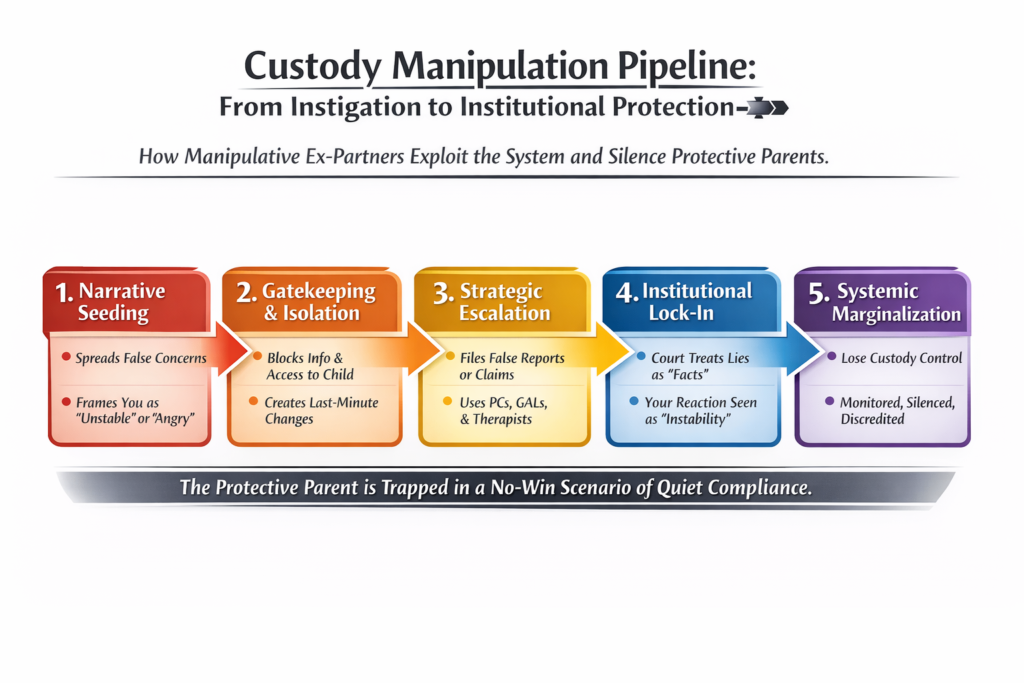
Decoding the Pattern
The diagram above reveals a common but rarely mapped progression: how an alienating or manipulative parent can exploit system blind spots to isolate, discredit, and ultimately erase a protective parent from their child’s life.
This isn’t about gender. It’s about power — and the institutional vulnerability to narratives crafted for plausible concern.
This page is part of the Signal-4 Codex — a living library of field-tested maps and resources for protective parents, fieldwalkers, and system survivors.
What This Map Shows
- Phase 1: Isolation – The other parent begins withholding communication, delaying coordination, or framing basic inquiries as aggression. Early warning signs are ignored by professionals who favor “co-parenting” platitudes over reality.
- Phase 2: False Concern Feedback Loop – Reactive responses to provable violations are reinterpreted as instability. Professionals begin to question the protective parent’s tone, not the other parent’s actions.
- Phase 3: Institutional Capture – Schools, therapists, or coordinators — often under pressure to stay neutral — begin treating the alienator’s narrative as the default truth. At this point, court actors may suggest “the child is doing fine” without the protective parent’s input.
Why This Matters
The system isn’t always malicious — but it is overloaded and easily misled. Alienating parents exploit this by appearing “reasonable” while triggering emotional or legal overreactions from the target.
The result? A loving parent is cast as a problem. The child loses access to truth, stability, and often their own voice.
Next in the Codex
- Strike Packets: Tactical legal and narrative countermeasures
- Custody Flip Signals: Early signs the system is beginning to recognize the truth
- Institutional Counter-Narratives: How to document, reframe, and protect the child’s bond
- Field Practice Tools: Emotional containment, energetic clarity, and alignment under pressure